When dealing with rebrands, we are often approached for specific advice on wayfinding and signage. It can be one of the most challenging visual touchpoints to update, and yet it is key to placemaking.
Our 20+ years heritage lies in the graphics industry, so there are few scenarios - shapes, sizes, formats, locations - that we have not helped to find a solution for.
Here are just a few of the headaches you might recognise:
- No two sites are the same - there is no one-size-fits-all solution
- Design guidelines often don't cover signage
- Sourcing materials that provide global brand consistency is difficult
- Site access is problematic
Design, manufacture, logistics and installation costs make it one of the most expensive items to replace.
Weigh these challenges against the prominence of building architectural signage, the high visual impact it can achieve in creating that all-important first impression, and the fact that good wayfinding makes or breaks the customer journey. It certainly pays to get it right.
We hope our five secrets will help you to navigate the world of global brand signage implementation.
01: Design Development
Many design agencies shy away from including signage in brand guidelines. There are simply too many scenarios and options which would make it a very costly exercise.

Specific sign family standards are required; these are often best developed by a specialist, who understands the core brand but also knows how to interpret your brand identity and apply it across different formats.
If you are dealing with multiple locations, it is useful to create a sign hierarchy that starts with architectural signs, following the customer journey throughout, including entrances, car parks and interior branding, right down to cafes and toilets.
If you are dealing with multiple locations, it is useful to create a sign hierarchy that starts with architectural signs, following the customer journey throughout, including entrances, car parks and interior branding, right down to cafes and toilets.
Interior signage can include workplace branding to create high-impact employee experiences.
Office design will be inspired by the home aesthetic to make it more appealing and comfortable, particularly now that so many of us have become accustomed to the home comforts of WFH.
02: Sign Selection and Design
There are many different sign types: pylons, totems, monuments, paint, panels, lightboxes, individual channel letters, flags and plaques, vinyl and clear window graphics, posters, foam letters, and floor graphics.
When choosing the best solution, consider:
- Purpose - navigational, informational or confirmational
- Weather conditions
- Design
- Product availability globally
- Planning or landlord restrictions
We often use 3M's Visual Attention Software to pinpoint the optimum location, size and design, helping to ensure the sign fits sympathetically within its surroundings.
Detailing helps to define exact requirements in terms of colour and materials, leading to a clear product specification.
Detailing helps to define exact requirements in terms of colour and materials, leading to a clear product specification.
Digital displays are increasingly prevalent, offering you the opportunity to regularly update and use interactive content.
03: Procurement
You are now ready to source your suppliers.
It is rarely desirable to manufacture centrally and ship signs around the world. Tempting as this may sound, because of the quality control and consistency it offers, it won't offer you cost efficiency, nor will it stand up to environmental scrutiny.
In many cases, it is possible to retrofit signs and recycling should be encouraged.
By working with a specialist, you can tap into a network of accredited suppliers where the quality of product and standards of manufacture are guaranteed.
A single point of contact helps to keep you in control of your brand, and where specific materials or products may not be available, your team will have a firm grip on what constitutes an acceptable compromise or alternative.
For larger facilities, commission a pilot site to check the robustness of the solution, particularly if it is to be rolled out far and wide.
04: Permits and Site Access
Companies rarely own all their sites. Often, property is rented and each landlord and each country will have a different set of regulations.
Restrictions include:
- Location
- Prominence - tenant hierarchy
- Size, style or colour
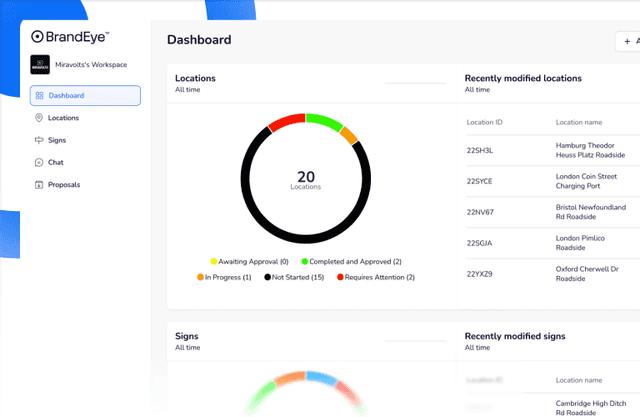
A local project manager, well versed in dealing with variations in law, can more smoothly manage the permit process, dealing with landlords and planning permission on your behalf. Once this information is fed into a central project management system, you can be confident that your global programme is on track in every market.
Communication and collaboration between all stakeholders is key - architects, landlords, designers, manufacturers and installers. This will help to minimise onsite disruption and reduce downtime when it comes to installation.
05: Site Surveys
The more thorough the site survey, the better the outcome. Accurate detailed measurements are key to successful implementation.

Work only with surveyors who are tried and tested, otherwise, you risk the expensive scenario of producing signs that are not fit for purpose, causing costly mistakes in terms of time, manufacture and installation.
Alternatively, use a proven self-survey tool and ensure that staff are well trained.
Bringing together all these partners will ensure that your designs are intuitive and that your signs clearly waymark a defined route for improved accessibility. And most importantly they will proudly showcase your brand.